Wind has a reputation for being the great equalizer in outdoor shooting.
That’s because it plays favorites with absolutely no one, and it also makes no apology for rearranging arrow flight paths, for nudging pellets off target, or for pushing long range bullets just enough to frustrate even the most seasoned of marksmen!
The key is not waiting for calm weather. Rather, it’s learning to shoot with the wind rather than fighting against it.
Understanding Wind as Part of the Terrain
Wind is rarely constant.
Anyone who spends enough time outdoors knows that what feels like a steady direction at one moment can shift and then swirl as soon as a shot is about to break. Tall grass may bend in one direction while a distant tree line moves completely differently.
Light gusts may appear and vanish. Even air temperature creates layers of movement, and especially in open fields or hot midday conditions.
But instead of thinking of wind as the enemy of precision, it actually really helps to see it as an instructor. When shots drift, when your groupings spread wide, or when consistent accuracy breaks down, the wind is offering notes.
Your goal should be to develop the ability to read those notes and adjust confidently…rather than guessing or simply hoping for better conditions!
Airgun Work: Let the Wind Teach Control
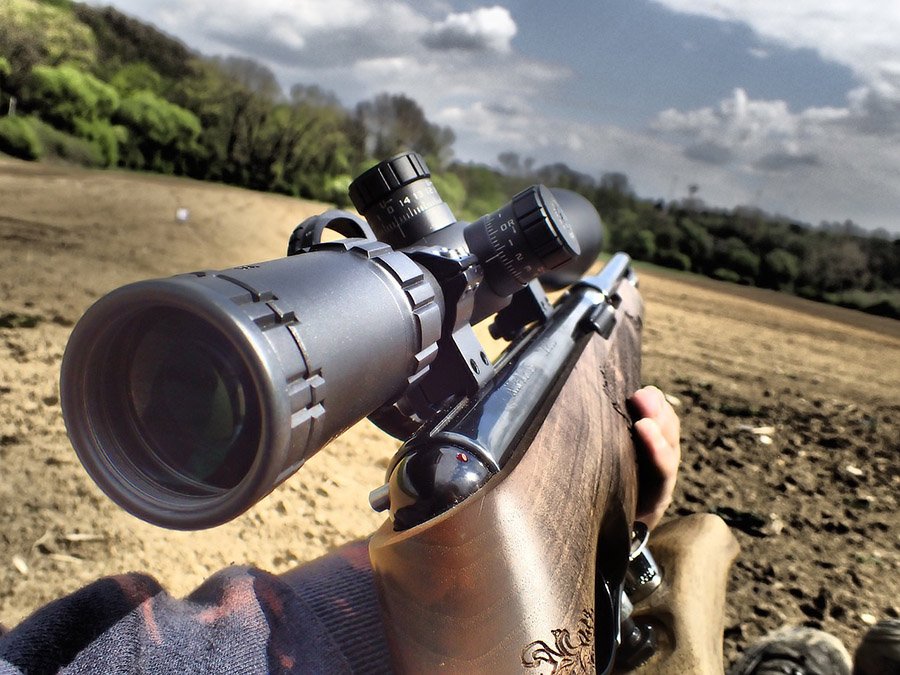
Airguns are more affected by wind than just about any other projectile platform. That makes windy conditions ideal for learning to hold control and rhythm!
One of the most effective practice setups that you can try out for air pistols and rifles involves placing small visual indicators at several distances. Something as simple as tape, ribbon, or yarn that is tied to sticks at intervals along the shooting lane will tell you a story about the wind’s behavior from muzzle to target.
Then you’ll need to work on grouping at known ranges and then you can adjust your hold based on what the indicators show. Over the course of time, your eye will learn how to read patterns rather than reacting to surprises.
Another useful exercise is, instead of firing immediately when the sight picture looks perfect, to instead wait for a moment when the wind settles into a recognizable pattern. The idea is not to chase the wind, but rather to let the shot break during a calm window that has been deliberately observed by you. The discipline that grows from this type of training carries into every other shooting skill as well.
For outdoor targets that can withstand repeat sessions in shifting weather, it can help to use durable field target setups, which can also be fun to shoot!
Bowhunting Practice: Wind Affects More Than Arrow Flight
Bowhunters deal with a second wind problem that rifle and airgun shooters do not, scent. The best shot in the world does not matter if the breeze carries a hunter’s scent straight to the animal. So that’s another way of saying that training in the wind is not just about accuracy so much as it is about approach and positioning…and maybe a little patience too.
One useful drill involves simply standing in a position that simulates a hunting setup and paying attention to stillness. The bow that you use needs to remain drawn only briefly, but the time that you spend waiting before the shot builds up your mental endurance that will be required for real field situations.
A partner, if you have somebody available, can also utilize a small bit of cloth or a lightweight streamer that will show how quickly wind shifts. The task for the two of you should be to learn how to remain calm and ready without chasing each movement like you may be accustomed too.
Another practice method is to walk, stop, draw, and release (rather than always shooting from a planted stance). You see, wind rarely lets a hunter choose perfect posture! That’s why it’s better to practice with the awkwardness that real hunts deliver than to wait for pristine form that never comes.

Tactical Rifle Work: Learning to Call the Wind
Rifle shooters who push distance must get really comfortable with interpreting not just the wind at the firing line, but also the wind conditions that are across the entire flight path of the bullet.
This, by the way, is precisely where experience comes from observation, and not speculation!
A simple way to begin is to watch how heat waves in the air move. On warm days especially, mirage patterns offer insight into wind layers. If the waves lean right or left, for instance, there is lateral push. If they shimmer upward, on the other hand, the air is stable.
Learning to call these patterns slowly turns wind from mystery into something that can be measured with the eyes. A spotter or shooting partner if you have anybody around can really help to confirm whether calls match results.
Another form of training involves shifting targets at varied distances. Engaging targets at three or four ranges back-to-back will naturally force you to make quick corrections. Instead of relying on one wind call for all shots, you’re going to learn that each distance may require a different correction, and that’s simply because that wind is rarely uniform across open space.
Bringing the Disciplines Together
While the equipment differs, the skills overlap:
Airgun shooters learn control and patience that benefits rifle work. Bowhunters learn stealth and wind awareness that benefits every shooter. Tactical rifle work improves spatial awareness and long range decision making that carries into any projectile discipline.
Any shooter who begins treating wind not as a disruption, but as a factor to be studied, begins improving faster than the one who only practices on calm days.
Wind can move a shot. It can change the tempo of a session. It can reshape a plan.
Yet with steady practice, it also will really become something that can sharpen your awareness and deepen your skills rather than causing disappointment!
Let’s put it this way, shooting in controlled conditions makes a shooter accurate.
Shooting in wind, however, makes a shooter capable.