


Central Asia’s natural symbols include the snow leopard of Kyrgyzstan, the Akhal-Teke horse of Turkmenistan and the eagle displayed on Kazakhstan’s flag. But not every animal or flower commonly described online as a “national symbol” has actually been given that status officially.
This guide covers the natural and cultural symbols of Kazakhstan, Kyrgyzstan, Tajikistan, Turkmenistan and Uzbekistan, distinguishing formally recognized symbols from important cultural associations and unofficial claims.
Central Asian National Symbols at a Glance
| Country | Main natural or cultural symbol | Other notable symbol | Status |
|---|---|---|---|
| Kazakhstan | Steppe/golden eagle | Tulip | Eagle is an official element of the national flag; no formal national-animal designation verified |
| Kyrgyzstan | Snow leopard | Tulip | Snow leopard officially recognized as a national symbol |
| Tajikistan | Marco Polo sheep | – | Promoted by authorities as a symbol or “brand”; formal national-animal designation not verified |
| Turkmenistan | Akhal-Teke horse | Alabai dog | Both are recognized by the government as important national symbols |
| Uzbekistan | Humo bird | Tulip | Humo is an official element of the state emblem; no formal national-animal designation verified |
The distinction matters. A species can be deeply connected with a country’s identity without being legally designated its “national animal” or “national flower.” This is also why different sources sometimes give conflicting answers.
National Symbols of Kazakhstan
What Is the National Animal of Kazakhstan?
Kazakhstan does not appear to have a formally designated national animal. The steppe eagle, however, is one of the country’s most important official animal symbols and appears prominently on Kazakhstan’s national flag.
The eagle is depicted flying beneath the sun at the center of the flag. According to the Government of Kazakhstan, the eagle has long occupied an important place in the worldview of Eurasian nomadic peoples. On the flag, it represents state power, sovereignty and independence, as well as the country’s aspirations toward the future. The eagle is also associated with freedom, courage, dignity and strength.
This cultural relationship extends beyond modern state symbolism. Golden eagles have been used for hunting on the Central Asian steppe for centuries, and the tradition of hunting with trained eagles remains particularly associated with Kazakh nomadic culture.
For this reason, the golden eagle is frequently described online as the “national animal of Kazakhstan.” That description captures its cultural importance, but we could not verify a law or official designation giving it that specific title. It is more accurate to describe the eagle as an official state symbol and one of Kazakhstan’s most recognizable animal emblems.

Does Kazakhstan Have a National Flower?
We could not verify an officially designated national flower of Kazakhstan. In particular, the claim that the lily is Kazakhstan’s national or unofficial national flower appears widely on secondary websites but is difficult to substantiate from authoritative Kazakh sources.
The tulip has a much stronger documented relationship with Kazakhstan.
Wild tulips have deep botanical roots in Central Asia, and Kazakhstan’s government actively presents the flower as part of the country’s natural and cultural heritage. President Kassym-Jomart Tokayev has referred to Kazakhstan as the birthplace of tulips, while a tulip was selected as the principal symbol of the country’s Nauryz celebrations.
That doesn’t make the tulip Kazakhstan’s official national flower. It does, however, make it a better-supported cultural and natural symbol than the lily sometimes presented as such online.
So the most accurate answer is:
Kazakhstan has no clearly verified official national flower, but the tulip is one of the flowers most strongly associated with the country’s natural heritage and national culture.
National Symbols of Kyrgyzstan
What Is the National Animal of Kyrgyzstan?
The snow leopard (Panthera uncia) is officially recognized as a national symbol of Kyrgyzstan. President Sadyr Japarov granted the species this status by presidential decree on December 29, 2023.
The designation reflects the snow leopard’s close association with Kyrgyzstan’s mountainous landscape and its place in the country’s cultural heritage. Much of Kyrgyzstan lies within the Tian Shan and Pamir-Alai mountain systems, which provide important habitat for this elusive high-altitude predator.
In announcing its national-symbol status, Kyrgyzstan’s Ministry of Natural Resources described the snow leopard as having an important role in the country’s culture, traditions and spiritual heritage. The government also linked protection of the species with the conservation of mountain ecosystems more broadly.
The designation has since become more concrete. In October 2025, Kyrgyzstan’s Cabinet of Ministers approved an official snow leopard national-symbol logo and established rules governing its use.
This makes Kyrgyzstan one of the clearest cases in Central Asia where an animal’s status as a national symbol can be traced directly to government action rather than simply being repeated by secondary sources.

Is the Markhor the National Animal of Kyrgyzstan?
No reliable evidence supports the commonly repeated claim that the markhor is Kyrgyzstan’s national animal. More importantly, the Kyrgyz government now explicitly recognizes the snow leopard as a national symbol.
The markhor (Capra falconeri) is a large wild goat native to mountainous areas of Central and South Asia, but its strongest national association is actually with Pakistan, where it is officially recognized as the national animal.
The appearance of the markhor as Kyrgyzstan’s national animal on various online lists is therefore likely the result of poorly sourced information being repeated between websites.
For anyone searching specifically for the national animal of Kyrgyzstan, the snow leopard is the answer supported by current official evidence.
Does Kyrgyzstan Have a National Flower?
We could not verify that Kyrgyzstan has an officially designated national flower.
Tulips are sometimes presented as the country’s national flower, and the association isn’t entirely arbitrary. Kyrgyzstan forms part of the Central Asian region where numerous wild tulip species occur, and these flowers are a familiar feature of its mountain and steppe landscapes.
However, cultural importance and native distribution are not the same as official designation. We found no equivalent of the 2023 snow-leopard decree formally establishing the tulip as Kyrgyzstan’s national flower.
It is therefore more accurate to describe wild tulips as characteristic flowers of Kyrgyzstan and Central Asia, rather than presenting the tulip as an officially recognized national flower.
National Symbols of Tajikistan
What Is the National Animal of Tajikistan?
The Marco Polo sheep (Ovis ammon polii) is widely associated with Tajikistan, particularly with the high mountains of the Pamirs, but we could not verify a formal designation naming it the country’s national animal.
Also known as the Pamir argali, the Marco Polo sheep is a subspecies of argali distinguished by the enormous curling horns of adult males. Its range extends across several mountainous areas of Central Asia, but Tajikistan’s Eastern Pamirs contain some of its most important habitat.
The animal consequently has a particularly strong association with Tajikistan’s mountainous identity. Tajik authorities have themselves promoted the Marco Polo sheep as a symbol of the country. In one government report discussing plans to install representations of the animal in cultural and recreational parks, it was explicitly described as a “brand of Tajikistan.”
That is meaningful evidence of national symbolism, but it is not quite the same thing as formally declaring the Marco Polo sheep the country’s national animal.
Tajikistan’s officially defined state symbols are its national flag, state emblem and national anthem. We could not find a law, presidential decree or comparable government document formally granting the Marco Polo sheep the title of national animal.

For that reason, the most accurate description is:
The Marco Polo sheep is one of Tajikistan’s most recognizable wildlife symbols and has been promoted by Tajik authorities as a national “brand,” but its frequently cited status as the official national animal could not be verified.
Its association with the country nevertheless makes sense. The sheep is closely linked with the remote Pamir landscape, one of Tajikistan’s defining natural features, and is an internationally recognizable representative of the country’s mountain wildlife.
Unlike some of the other countries in this guide, there isn’t enough reliable evidence for additional natural emblems to justify manufacturing separate sections for a supposed national bird or national flower. In this case, the Marco Polo sheep is the relevant symbol, and that’s where the evidence stops.
National Symbols of Turkmenistan
What Is the National Animal of Turkmenistan?
The Akhal-Teke horse is one of Turkmenistan’s most important national symbols and appears at the center of the country’s state emblem.
The Akhal-Teke is an ancient horse breed closely associated with the Turkmen people. Known for its endurance, speed and distinctive appearance, the breed developed under the demanding conditions of Central Asia and has been part of Turkmen culture for centuries.
Its significance goes well beyond being a native horse breed. Turkmenistan’s government regularly describes the Akhal-Teke as a national symbol, and its image occupies the central position on the country’s state emblem. Official sources connect the horse with Turkmen history, cultural heritage and national identity.
The breed remains highly prominent in modern Turkmenistan. The country celebrates an annual National Turkmen Horse Day, while breeding, equestrian events and the preservation of Akhal-Teke bloodlines receive considerable state attention.
The horse’s cultural importance has also received international recognition. In 2023, UNESCO inscribed the art of Akhal-Teke horse breeding and traditions of horses’ decoration on its Representative List of the Intangible Cultural Heritage of Humanity.
For someone asking for the national animal of Turkmenistan, the Akhal-Teke horse is therefore the strongest answer. While Turkmenistan’s Constitution defines the flag, emblem and anthem as its formal state symbols, government sources explicitly and repeatedly recognize the Akhal-Teke as a national symbol.

The Alabai: Turkmenistan’s Other Important Animal Symbol
The Akhal-Teke isn’t Turkmenistan’s only animal with strong national significance. The Turkmen Alabai, a traditional livestock guardian dog, is also officially promoted as part of the country’s national heritage.
Turkmenistan’s government describes the Alabai alongside the Akhal-Teke horse and traditional carpets as one of the country’s national symbols. The breed developed alongside pastoral communities, where these powerful dogs protected livestock and property.
Turkmenistan even celebrates a national holiday dedicated to the breed, the Day of the Turkmen Alabai.
This makes Turkmenistan unusual within Central Asia in having two domestic animal breeds so explicitly incorporated into modern national symbolism.
Does Turkmenistan Have a National Bird?
We could not verify the frequently repeated claim that the black francolin (Francolinus francolinus) is the national bird of Turkmenistan.
The black francolin does occur in Turkmenistan and elsewhere across parts of Asia, but its presence in the country does not establish national-symbol status. We found no reliable government designation or other authoritative evidence naming it Turkmenistan’s national bird.
It is therefore better treated as a bird found in Turkmenistan, not a verified national bird.
Does Turkmenistan Have a National Flower?
We could not verify an official or reliably established unofficial national flower for Turkmenistan.
Some online lists identify the red rose as Turkmenistan’s unofficial national flower, but we found no authoritative evidence supporting that designation.
Rather than repeat a claim simply because it appears across multiple national-symbol lists, it is more accurate to say that Turkmenistan does not appear to have a clearly documented national flower.
National Symbols of Uzbekistan
What Is the National Animal of Uzbekistan?
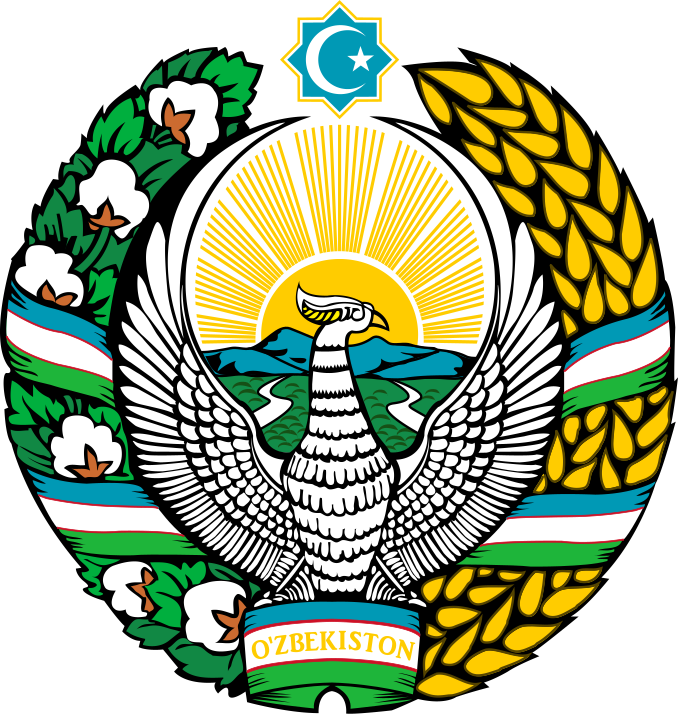
Uzbekistan does not appear to have a formally designated national animal. One of the country’s most important animal symbols is instead the Humo, a legendary bird depicted on Uzbekistan’s state emblem.
Unlike the snow leopard of Kyrgyzstan or the Akhal-Teke horse of Turkmenistan, the Humo is not a living species. It is a mythical bird with roots in Persian and Central Asian tradition, sometimes compared with the phoenix or the legendary Simurgh.
On Uzbekistan’s state emblem, the Humo appears at the center with its wings spread. The official website of the President of Uzbekistan describes it as a symbol of national renaissance, while government descriptions also associate the bird with happiness and freedom.
The Humo therefore has much stronger documented national significance than any living animal commonly presented online as Uzbekistan’s “national animal.”
Its symbolism also extends beyond the emblem. The Humo is used extensively in Uzbek public imagery and institutions, making it one of the country’s most recognizable cultural symbols.
For someone searching for the national animal of Uzbekistan, the most accurate answer is therefore that Uzbekistan has no clearly verified official national animal, while the mythical Humo bird serves as an important official animal-like symbol of the country.
Does Uzbekistan Have a National Flower?
We could not verify that Uzbekistan has an officially designated national flower. The tulip is sometimes described online as Uzbekistan’s national or unofficial national flower, but authoritative evidence for that designation is lacking.
Tulips do, however, have a genuine connection with Uzbekistan and the wider Central Asian region. Wild tulips grow naturally in the country’s mountains and foothills, and the flower has a long place in local spring traditions.
One particularly interesting example is Lola Sayli, literally a “tulip festival.” Historically celebrated during spring, these festivities were associated with the flowering of tulips and other seasonal plants and formed part of traditional Uzbek social and cultural life. Academic research documents the importance of these celebrations in Uzbek culture.
So, as with Kazakhstan and Kyrgyzstan, there is a useful distinction to make:
Tulips are an important part of Uzbekistan’s natural and cultural heritage, but that does not make the tulip a verified official national flower.
Official vs. Unofficial National Symbols: Why Do Sources Disagree?
Search for the national animal, bird or flower of almost any Central Asian country and you may find surprisingly confident but contradictory answers.
The main reason is simple: cultural significance does not necessarily mean official designation.
A country can have several different kinds of symbols:
- Official state symbols are established in constitutions, laws or other government acts. These typically include the national flag, emblem and anthem.
- Officially recognized cultural or natural symbols may receive government recognition without becoming constitutional state symbols. Kyrgyzstan’s snow leopard is a good example.
- Traditional symbols can have centuries of cultural significance without ever being formally designated. Kazakhstan’s relationship with the eagle falls partly into this category, although the eagle also appears on the national flag.
- Unofficial associations may be widely accepted but have no formal status.
- Poorly sourced claims can spread from one website to another until they appear authoritative despite having little evidence behind them.
This last category appears to explain several claims commonly made about Central Asia. We could find no authoritative support, for example, for the lily as Kazakhstan’s national flower, the markhor as Kyrgyzstan’s national animal, the black francolin as Turkmenistan’s national bird, or the red rose as Turkmenistan’s national flower.
This guide therefore uses terms such as official national symbol, cultural symbol and widely associated with deliberately rather than treating them as interchangeable.
Frequently Asked Questions
Do all Central Asian countries have national animals?
No. Kyrgyzstan officially recognizes the snow leopard as a national symbol, while Turkmenistan explicitly recognizes animals such as the Akhal-Teke horse as important national symbols. In other countries, animals commonly described as “national animals” may instead be cultural, heraldic or wildlife symbols without a verified formal national-animal designation.
Which Central Asian country has the snow leopard as a national symbol?
Kyrgyzstan officially recognized the snow leopard as a national symbol in December 2023. The species is closely associated with the country’s mountainous landscapes and is also important to conservation efforts across the Tian Shan.
Which country is associated with the Akhal-Teke horse?
The Akhal-Teke horse is strongly associated with Turkmenistan, where it is recognized as a national symbol and depicted at the center of the state emblem. Turkmenistan also celebrates National Turkmen Horse Day.
Are tulips national flowers in Central Asia?
Tulips are important natural and cultural symbols across Central Asia, but that doesn’t necessarily make them official national flowers.
The region is an important center of wild tulip diversity, and the flowers have longstanding cultural associations in countries including Kazakhstan, Kyrgyzstan and Uzbekistan. However, we could not verify formal national-flower designations for the countries covered in this guide.
What are the official state symbols of Central Asian countries?
The five Central Asian republics formally recognize their national flags, state emblems and national anthems as core state symbols. Animals and plants may additionally appear on those emblems or receive separate cultural or governmental recognition, but their legal status varies from country to country.
Sources & Further Reading
- Kazakhstan – Government of Kazakhstan: State Symbols
Excellent primary source for the steppe eagle on the national flag and what it represents: sovereignty, independence, freedom, courage and strength. Government of Kazakhstan
Government of Kazakhstan – State Symbols - Kyrgyzstan – Ministry of Natural Resources: Snow Leopard as National Symbol
This is probably the most important source in the article. It confirms that Presidential Decree No. 369 of 29 December 2023 officially recognized the snow leopard as a national symbol. mnr.gov.kg
Kyrgyz Ministry of Natural Resources – Snow Leopard National Symbol - Kyrgyzstan – Cabinet approval of official snow leopard symbol
Confirms the subsequent 2025 implementation and official logo. mnr.gov.kg
Kyrgyz Ministry of Natural Resources – 2025 Snow Leopard Decision - Tajikistan – Ministry of Internal Affairs: “Marco Polo – Brand of Tajikistan”
Particularly useful because it supports exactly the distinction we made: Tajik authorities promote the Marco Polo sheep as a national “brand”, but this is not evidence of a formal national-animal designation. mvd.tj
Tajikistan Ministry of Internal Affairs – Marco Polo, Brand of Tajikistan - Turkmenistan – Government: Akhal-Teke horse
Very strong current source. It explicitly describes the Akhal-Teke at the center of the State Emblem as a treasured national symbol. turkmenistan.gov.tm
Government of Turkmenistan – Global Fame of Akhal-Teke Horses - Turkmenistan – Government: Akhal-Teke and Alabai
Useful for the secondary Alabai discussion and broader national-symbol context. turkmenistan.gov.tm
Government of Turkmenistan – Akhal-Teke and Turkmen Alabai - Uzbekistan – President of Uzbekistan: State Symbols
Primary source for the Humo/Semurg bird on the state emblem and its symbolism as national renaissance. President of Uzbekistan
President of Uzbekistan – State Symbols


