


South Asia’s national symbols range from Pakistan’s markhor and Bhutan’s takin to Bangladesh’s water lily and the coconut palm of the Maldives. Some are formally designated by governments, while others are traditional or widely repeated associations whose official status is much less clear.
This guide covers the national animals, birds, flowers and trees of Afghanistan, Bangladesh, Bhutan, India, the Maldives, Nepal, Pakistan and Sri Lanka. Where a commonly cited national symbol could not be verified from authoritative sources, this is clearly indicated rather than treating the claim as established fact.
South Asian National Symbols at a Glance
| Country | National animal | National bird | National flower | National tree |
|---|---|---|---|---|
| Afghanistan | Snow leopard* | Golden eagle* | Tulip* | Afghan pine* |
| Bangladesh | Royal Bengal tiger | Oriental magpie-robin | White water lily | Mango tree |
| Bhutan | Takin | Raven | Blue poppy | Cypress |
| India | Tiger | Indian peafowl | Lotus** | Banyan |
| Maldives | Yellowfin tuna* | White-breasted waterhen | Finifenmaa (pink rose) | Coconut palm |
| Nepal | Cow | Himalayan monal (Danfe) | Rhododendron arboreum (Lali Gurans) | No verified official designation |
| Pakistan | Markhor | Chukar partridge | Jasmine | Deodar |
| Sri Lanka | No verified official designation | Sri Lankan junglefowl | Nil Manel | Ceylon ironwood (Na) |
* Commonly cited as a national symbol, but we could not verify a formal national designation from authoritative sources.
** The lotus is recognized as India’s national flower by government sources, although the Indian government has previously stated that no separate formal notification designating a national flower had been issued.
The distinction between official and commonly cited symbols is important. Cultural importance alone does not necessarily make an animal or plant an officially designated national symbol, and some claims have been repeated online for years despite having little authoritative evidence behind them.
National Symbols of Afghanistan
Afghanistan is the most difficult country in South Asia when it comes to establishing a definitive set of natural national symbols. The snow leopard, golden eagle, tulip and Afghan pine are all commonly presented as Afghanistan’s national animal, bird, flower and tree respectively, but we could not verify formal government designations for these claims.
What Is the National Animal of Afghanistan?
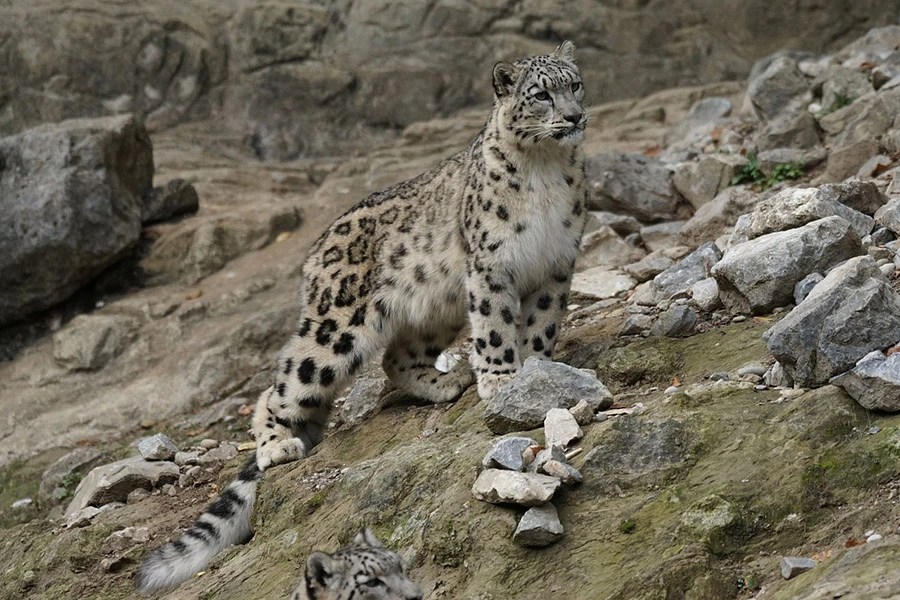
The snow leopard (Panthera uncia) is commonly described as the national animal of Afghanistan, although we could not verify an official designation granting it that status.
The association is nevertheless grounded in Afghanistan’s natural heritage. Snow leopards inhabit the country’s remote northeastern mountains, particularly the Wakhan Corridor and Hindu Kush, where rugged high-altitude terrain provides suitable habitat for the species.
Afghanistan has also taken measures to protect snow leopards. The species has conservation importance in the country and is one of the most recognizable animals of its mountain ecosystems.
It is therefore reasonable to describe the snow leopard as an important wildlife symbol of Afghanistan. Calling it the country’s formally designated national animal, however, goes beyond what the available authoritative evidence establishes.
What Is the National Bird of Afghanistan?
The golden eagle (Aquila chrysaetos) is frequently identified as Afghanistan’s national bird, but its official status could not be verified.
Golden eagles occur across Afghanistan’s mountainous landscapes and have a much broader historical association with the peoples and cultures of Central and South-Central Asia. Their size, hunting ability and preference for dramatic mountain environments have also made them powerful symbols across the region.
However, we could not locate an authoritative Afghan law or government source formally designating the golden eagle as the country’s national bird.
It is therefore better described as a widely cited national bird and an important bird of Afghanistan’s mountain landscapes, rather than an unquestionably official national symbol.

What Is the National Flower of Afghanistan?
The tulip is widely described as Afghanistan’s national flower, although a formal national-flower designation could not be verified.
Unlike some questionable national-symbol associations, the connection between Afghanistan and tulips is not arbitrary. Wild tulips occur naturally across parts of the country and have long been associated with spring, gardens and the landscapes of the wider region.
Tulips also carry cultural significance across Persian and Central Asian traditions, of which Afghanistan has historically been a part.
Still, cultural importance is different from official status. In the absence of a verifiable government designation, the most accurate description is that the tulip is a culturally significant flower commonly cited as Afghanistan’s national flower.
What Is the National Tree of Afghanistan?
The Afghan pine (Pinus eldarica) is often listed as Afghanistan’s national tree, but we could not verify an official designation.
Despite its common name, even the species’ relationship with Afghanistan requires some care. Pinus eldarica, also known as the Eldar pine, is associated primarily with parts of the Caucasus and surrounding regions and has been widely planted elsewhere because of its tolerance of dry conditions.
This makes the confident designation of the Afghan pine as Afghanistan’s official national tree particularly difficult to support.
Afghanistan certainly has important native forest ecosystems, including conifer forests in its eastern mountains, but no formally designated national tree could be established from the authoritative sources we reviewed.
For this reason, the Afghan pine should be treated as a commonly repeated association rather than a verified national symbol.
National Symbols of Bangladesh
Bangladesh has a clearly established set of natural national symbols. Its tiger, bird, flower and tree are all recognized by government sources and have strong connections with the country’s landscapes and culture.

What Is the National Animal of Bangladesh?
The Royal Bengal tiger (Panthera tigris tigris) is the national animal of Bangladesh.
Its national significance is closely connected with the Sundarbans, the vast mangrove forest spanning southwestern Bangladesh and neighboring India. The Bangladeshi Sundarbans support one of the world’s best-known populations of Bengal tigers and form an important part of the country’s natural heritage.
The tiger represents strength and courage and appears prominently in Bangladeshi culture and public life. Its importance is also reflected in the country’s conservation efforts, as habitat loss, human-wildlife conflict and other pressures continue to threaten the species.
Rather than simply being an animal selected to represent the country, the Bengal tiger therefore has a direct ecological connection with one of Bangladesh’s most distinctive landscapes.
What Is the National Bird of Bangladesh?
The Oriental magpie-robin (Copsychus saularis), locally known as the Doyel or Doel, is the national bird of Bangladesh.
This small black-and-white songbird is widespread across the country and is familiar in both rural and urban environments. Its clear, varied song makes it particularly noticeable despite its modest appearance.
The Doyel has become a familiar symbol of Bangladeshi identity. It appears on Bangladeshi currency, while landmarks such as Dhaka’s Doyel Chattar, or Doyel Square, also reflect its place in national culture.
Unlike national birds chosen primarily for their rarity or imposing appearance, the Doyel represents a species that many people in Bangladesh can encounter in everyday life.

What Is the National Flower of Bangladesh?
The white water lily, known in Bengali as Shapla, is the national flower of Bangladesh.
Water lilies are a natural fit for a country shaped so extensively by water. Bangladesh lies across the enormous Ganges-Brahmaputra-Meghna delta and contains countless rivers, wetlands, ponds and seasonally flooded areas where aquatic plants form a familiar part of the landscape.
The Shapla’s national importance is particularly visible on the national emblem of Bangladesh, where a water lily occupies the central position.
Its significance is therefore both ecological and official: the flower represents the wetland landscapes that characterize much of Bangladesh while also forming part of the country’s state imagery.
What Is the National Tree of Bangladesh?
The mango tree (Mangifera indica) is the national tree of Bangladesh.
The designation was formally approved by the Bangladeshi government in 2010, giving official recognition to a tree already deeply embedded in the country’s landscapes, food culture and rural life.
Mango trees are widespread throughout Bangladesh, where they provide fruit, shade and economic value. The northwestern district of Rajshahi and surrounding areas are particularly well known for mango cultivation.
Choosing the mango as the national tree therefore reflects something commonplace rather than exotic: a tree closely connected with everyday life across Bangladesh and one of the country’s most important cultivated fruits.
National Symbols of Bhutan
Bhutan has a well-established set of natural national symbols, each closely connected with the country’s wildlife, culture and Buddhist traditions.

What Is the National Animal of Bhutan?
The takin (Budorcas taxicolor) is the national animal of Bhutan. This unusual Himalayan mammal belongs to the same family as goats, sheep and cattle and inhabits forested mountain slopes and alpine areas.
The takin has a particularly distinctive place in Bhutanese folklore. According to tradition, the 15th-century Buddhist saint Drukpa Kunley, known as the Divine Madman, was asked to perform a miracle. After eating a goat and a cow, he supposedly placed the goat’s head onto the cow’s skeleton and brought the animal to life, creating the takin.
Beyond the legend, takins are genuinely part of Bhutan’s native wildlife. They move between forest and alpine habitats according to the season, sometimes gathering in sizeable groups during summer.
The combination of endemic cultural significance and a real connection with Bhutan’s Himalayan environment helps explain why such an unusual animal became a national symbol.
What Is the National Bird of Bhutan?
The raven is the national bird of Bhutan and has a particularly strong connection with the country’s monarchy and religious history.
A raven surmounts the Raven Crown worn by Bhutan’s kings. The bird represents Mahakala, a protective deity important in Bhutanese Buddhism and regarded as a guardian of the country.
The symbolism predates Bhutan’s modern monarchy. The Raven Crown was developed from a battle helmet worn by Jigme Namgyel, father of Bhutan’s first king, during the 19th century. Its raven motif represented divine protection.
Ravens are also naturally at home in Bhutan’s mountainous environment, so the national bird combines religious, historical and ecological associations.
What Is the National Flower of Bhutan?
Bhutan’s national flower is the blue poppy, currently identified as Meconopsis gakyidiana.
The flower grows in high-altitude environments and is known for its striking blue to purplish-blue petals. Its association with Bhutan’s remote Himalayan landscapes makes it an appropriate botanical symbol of the country.
Its scientific identity has an interesting history. Bhutan’s national flower was previously associated with Meconopsis grandis, but botanical research eventually showed that the Bhutanese plant represented a distinct species. It was formally described as Meconopsis gakyidiana in 2017.
The name gakyidiana derives from Gakyid, a Dzongkha concept associated with happiness and closely connected with Bhutan’s philosophy of Gross National Happiness.
This makes the blue poppy more than a decorative national emblem: even its modern scientific name has a distinctly Bhutanese connection.

What Is the National Tree of Bhutan?
The cypress is the national tree of Bhutan. It is commonly identified with the Himalayan or Bhutan cypress (Cupressus torulosa), although botanical naming within this group can vary between sources.
Tall cypresses are a familiar sight around monasteries, dzongs and religious sites in Bhutan. The tree has long been valued for its durability and fragrance and carries strong associations with religious and cultural life.
Cypresses also thrive in Bhutan’s mountainous environment. Their ability to grow on difficult terrain and withstand harsh conditions has contributed to associations with resilience and longevity.
As with Bhutan’s other natural symbols, the choice reflects something found not only in national imagery but also in the country’s physical and cultural landscape.
National Symbols of India
India has several widely recognized natural national symbols, including the tiger, Indian peafowl, lotus and banyan tree. Their status is well established in Indian government material, although the lotus has an interesting distinction between government recognition and formal notification.
What Is the National Animal of India?
The tiger (Panthera tigris) is the national animal of India. More specifically, India’s wild tigers belong to the Bengal tiger subspecies, Panthera tigris tigris.
The tiger was adopted as India’s national animal in 1973, replacing the lion. Its selection coincided with growing concern over the dramatic decline of India’s tiger population and the launch of Project Tiger, the country’s major tiger conservation programme.
India’s National Portal describes the tiger as representing grace, strength, agility and enormous power. The choice also has an obvious ecological connection: India supports by far the world’s largest remaining wild tiger population.
The tiger therefore serves both as a national emblem and as the flagship species for one of India’s most important wildlife conservation efforts.

What Is the National Bird of India?
The Indian peafowl (Pavo cristatus), commonly known as the peacock, is the national bird of India. It was designated in 1963.
The species occurs naturally across much of the Indian subcontinent and is immediately recognizable by the male’s iridescent blue plumage and spectacular train of elongated feathers.
Its significance in India extends far beyond its appearance. Peafowl have featured in Indian art, mythology, religion and literature for centuries. The bird is associated with several Hindu deities, including Krishna and Kartikeya, and peacock imagery appears extensively in traditional architecture and decorative arts.
India’s government describes the peacock as being closely connected with the country’s culture and traditions, making its designation a combination of natural distribution and longstanding cultural significance.
What Is the National Flower of India?
The lotus (Nelumbo nucifera) is recognized by Indian government sources as India’s national flower, although its formal status is slightly more complicated than this simple description suggests.
The lotus has an exceptionally long history in Indian culture. It appears extensively in Hindu and Buddhist symbolism and is associated with purity, beauty and spiritual development. Deities including Lakshmi and Brahma are traditionally depicted with lotus flowers, while lotus imagery has been used in Indian art and architecture for centuries.
The plant’s growth habit contributes to its symbolism. Lotus flowers emerge above muddy or shallow water while remaining visually clean, an image that has long been used as a metaphor for purity and spiritual detachment.
There is, however, an unusual administrative detail. Indian government websites routinely identify the lotus as the country’s national flower, but the government has previously told Parliament that no separate formal notification declaring a national flower had been issued.
So both statements can be true: the lotus is recognized and presented by the Government of India as the national flower, even though its status does not appear to derive from the same kind of formal notification used for some other national symbols.

What Is the National Tree of India?
The banyan (Ficus benghalensis) is the national tree of India.
Banyans are famous for their aerial roots, which descend from spreading branches and eventually reach the ground, where they develop into additional trunk-like supports. Over time, a single tree can spread across an extraordinary area and resemble a small grove.
This unusual growth pattern has helped give the banyan associations with longevity and continuity. Individual trees can survive for centuries while continually producing new supporting roots.
Banyan trees also have longstanding cultural and religious importance in India. Their broad canopies traditionally provide gathering places and shade, while species of Ficus occupy an important place in Hindu, Buddhist and Jain traditions.
The banyan consequently represents more than an impressive native tree. Its longevity, continually expanding structure and place in community and religious life help explain its role as one of India’s natural national symbols.
National Symbols of the Maldives
The Maldives has well-established national symbols in its bird, flower and tree. The frequently cited yellowfin tuna is more complicated: its importance to Maldivian life is unquestionable, but we could not verify its formal designation as the country’s national animal.
What Is the National Animal of the Maldives?
The yellowfin tuna (Thunnus albacares) is frequently described as the national animal of the Maldives, but we could not verify an official designation giving it that status.
The association is understandable. Tuna fishing has been central to Maldivian livelihoods, food and trade for centuries, and tuna remains one of the country’s most economically important marine resources. Yellowfin tuna is a major component of the modern Maldivian fishery alongside skipjack tuna.
The Maldives is also particularly known for its traditional pole-and-line fishing methods, which have long been used to catch tuna individually rather than with large industrial nets.
But economic and cultural importance should not be confused with formal national-symbol status. Authoritative Maldivian fisheries sources document the importance of yellowfin tuna extensively without identifying it as the country’s national animal.
The most accurate description is therefore that yellowfin tuna is an important marine and cultural symbol of the Maldives that is commonly cited as its national animal, although a formal designation could not be verified.

What Is the National Bird of the Maldives?
The white-breasted waterhen (Amaurornis phoenicurus), locally known as Kanbili, is the national bird of the Maldives.
This distinctive waterbird has dark upperparts, a white face and breast, and long yellowish legs. It occurs around wetlands, vegetated areas and freshwater habitats on Maldivian islands.
Unlike the vast numbers of seabirds associated with the archipelago, the Kanbili is closely connected with the terrestrial and wetland environments of the islands themselves. Maldivian environmental authorities explicitly recognize the white-breasted waterhen as the country’s national bird.
What Is the National Flower of the Maldives?
The Finifenmaa, or pink rose (Rosa polyantha), is the national flower of the Maldives. It was declared the country’s national flower on 25 July 1985.
Finifenmaa means rose in Dhivehi, and the flower is valued for its delicate pink blossoms and fragrance. Although roses are not plants that most outsiders immediately associate with a tropical coral archipelago, the Finifenmaa has become an established part of Maldivian national symbolism.
Its official designation also makes the Maldives different from several countries in this guide where supposed “national flowers” are based largely on cultural association or repeated secondary claims.

What Is the National Tree of the Maldives?
The coconut palm (Cocos nucifera), known in Dhivehi as Dhivehi Ruh, is the national tree of the Maldives.
Few national-tree choices have such an obvious relationship with the country they represent. Coconut palms are exceptionally well adapted to tropical island environments and have historically supplied Maldivian communities with food, drink, timber, fibre and material for traditional crafts and construction.
Different parts of the palm could be put to practical use: coconuts provided food and oil, leaves were used for thatching and weaving, timber served construction needs, and coir fibre became important for rope-making.
The coconut palm also appears on the national emblem of the Maldives, reflecting its importance well beyond its familiar role in the country’s tropical scenery.
Its status as the national tree therefore represents a species that has directly supported everyday life on the islands for generations.
National Symbols of Nepal
Nepal’s national animal and flower are established directly in the country’s Constitution, while the Himalayan monal is firmly recognized as the national bird. The supposed national-tree designation of the sacred fig is much less clear.
What Is the National Animal of Nepal?
The cow is the national animal of Nepal, a status explicitly established by the Constitution of Nepal.
The choice reflects the cow’s deep cultural and religious significance in the country. Cows are sacred in Hinduism, the religion followed by a majority of Nepal’s population, and are traditionally associated with prosperity, motherhood and the goddess Lakshmi.
This status has a visible place in Nepalese traditions. During Gai Tihar, one day of the annual Tihar festival is dedicated specifically to honoring cows. They are decorated, offered food and marked with tika as part of the celebrations.
Unlike some of the unofficial animal associations elsewhere in South Asia, there is no ambiguity about the cow’s national status: Nepal’s Constitution explicitly states that the cow shall be the national animal of Nepal.

What Is the National Bird of Nepal?
The Himalayan monal (Lophophorus impejanus), known in Nepal as the Danfe or Daphne, is the national bird of Nepal.
The Himalayan monal is a high-altitude pheasant found across the Himalayas. In Nepal, it inhabits mountain forests, shrublands and alpine areas, generally moving between elevations according to the season.
Male monals are particularly striking. Their plumage combines iridescent shades of green, blue, purple, copper and orange, while females have much more subdued mottled brown plumage that provides effective camouflage.
The Danfe has become one of Nepal’s most recognizable wildlife symbols and is closely associated with the country’s Himalayan landscapes. Its Nepali name is also widely used in cultural references, including traditional songs and imagery.
For someone searching for Nepal’s national bird, the answer is therefore straightforward: the Himalayan monal, or Danfe.
What Is the National Flower of Nepal?
The national flower of Nepal is Rhododendron arboreum, locally known as Lali Gurans. Its status is explicitly recognized in Nepal’s Constitution.
The species produces conspicuous clusters of red flowers and grows naturally across Nepal’s hills and mountains. During the flowering season, rhododendrons can cover forested slopes with large areas of red and pink.
Rhododendrons are particularly characteristic of Nepal’s middle and higher elevations, and the country contains numerous species within the genus. Rhododendron arboreum, however, is the species specifically identified as the national flower.
Its bright red flowers are widely used in Nepalese imagery and cultural references, making the Lali Gurans both an officially recognized symbol and a plant with a genuine connection to the country’s mountain environment.

Does Nepal Have a National Tree?
We could not verify an officially designated national tree of Nepal from authoritative government sources.
The sacred fig (Ficus religiosa), also known as the peepal or Bodhi tree, is sometimes identified online as Nepal’s national tree. It unquestionably has enormous religious and cultural importance in Nepal, where sacred figs are commonly found near temples, shrines and traditional gathering places.
The species is particularly important in both Hinduism and Buddhism. Most famously, Buddhist tradition holds that Siddhartha Gautama attained enlightenment beneath a sacred fig at Bodh Gaya, giving the species its familiar name of Bodhi tree.
However, cultural importance does not establish national-tree status. Nepal’s Constitution explicitly identifies the cow as the national animal and Rhododendron arboreum as the national flower, while we could not find comparable authoritative evidence designating Ficus religiosa as the national tree.
It is therefore more accurate to describe the sacred fig as one of Nepal’s most culturally and religiously significant trees, rather than confidently presenting it as the country’s official national tree.
National Symbols of Pakistan
Pakistan has a clearly established set of natural national symbols. The markhor, chukar partridge, jasmine and deodar are all identified as national symbols by Pakistani government sources.

What Is the National Animal of Pakistan?
The markhor (Capra falconeri) is the national animal of Pakistan. This large wild goat is particularly recognizable by the spectacular corkscrew-shaped horns of adult males.
Markhors inhabit rugged mountainous terrain across parts of Pakistan, especially in the country’s northern and western mountain ranges. Their ability to negotiate steep rocky slopes makes them particularly well suited to these environments.
The markhor also represents one of Pakistan’s notable wildlife conservation stories. Populations suffered heavily from hunting and other pressures, but community-based conservation initiatives have contributed to significant recoveries in some areas.
Its national status has recently gained an additional international dimension. In 2024, the United Nations General Assembly proclaimed 24 May as the International Day of the Markhor, following a resolution sponsored by Pakistan and other countries.
The animal’s distinctive appearance, mountain habitat and conservation significance have made it one of Pakistan’s most recognizable wildlife symbols.
What Is the National Bird of Pakistan?
The chukar partridge (Alectoris chukar) is the national bird of Pakistan.
Chukars are compact gamebirds recognizable by their pale body, black band running across the forehead and around the throat, and boldly barred flanks. They inhabit rocky hillsides, mountain slopes and other dry, rugged landscapes.
The species occurs widely across Pakistan’s mountainous regions and is particularly associated with the country’s northern and western landscapes.
The chukar also has a place in regional culture and folklore. Its distinctive call and association with remote mountain terrain have made it a familiar bird well beyond its official national status.

What Is the National Flower of Pakistan?
Jasmine is the national flower of Pakistan.
Known for its small white flowers and strong fragrance, jasmine is widely cultivated in gardens and around homes throughout the country. Its flowers are also used for garlands, decoration and traditional occasions.
White jasmine is commonly associated with purity, simplicity and modesty, qualities frequently connected with its role as Pakistan’s national flower.
Unlike several supposed national flowers elsewhere in South Asia that are difficult to trace to authoritative sources, jasmine is explicitly identified as Pakistan’s national flower by government sources.
What Is the National Tree of Pakistan?
The deodar (Cedrus deodara), also known as the Himalayan cedar, is the national tree of Pakistan.
This large evergreen conifer grows naturally in the western Himalayas, including the mountain forests of northern Pakistan. Mature deodars can develop massive trunks and broad crowns, making them among the most imposing trees of the region’s temperate forests.
The name deodar derives from Sanskrit words meaning “timber of the gods,” reflecting the tree’s longstanding cultural and religious importance across the Himalayan region.
Its durable, aromatic wood has historically been valued for buildings and other forms of construction. Ecologically, deodar forests also provide important mountain habitat.
As Pakistan’s national tree, the deodar therefore represents the forested Himalayan landscapes of northern Pakistan as well as a species with a long cultural history across South Asia.
National Symbols of Sri Lanka
Sri Lanka has officially recognized national symbols in its bird, flower and tree. Its supposed national animal is less straightforward: several species are described as such, but we could not verify a formal designation.
What Is the National Animal of Sri Lanka?
Sri Lanka does not appear to have an officially designated national animal. The grizzled giant squirrel is frequently given this title online, but authoritative sources do not establish it as a formally recognized national symbol.
The grizzled giant squirrel (Ratufa macroura) is nevertheless an important part of Sri Lanka’s wildlife. This large tree squirrel occurs in Sri Lanka and southern India, with Sri Lanka supporting endemic subspecies. Its long tail, contrasting coat and largely arboreal lifestyle make it one of the island’s more distinctive mammals.
However, it is not the only animal associated with Sri Lankan national identity. The Sri Lankan elephant has immense cultural, religious and historical significance, and some Sri Lankan sources have referred to it as a national animal. The lion, meanwhile, occupies the most prominent place in the country’s official symbolism, appearing at the center of the national flag despite lions no longer occurring naturally on the island.
These competing associations help explain why different sources give different answers.
The safest answer is therefore: Sri Lanka has several important animal symbols, but we could not verify a formally designated national animal. The widespread claim that the grizzled giant squirrel holds this official title should be treated cautiously.

What Is the National Bird of Sri Lanka?
The Sri Lankan junglefowl (Gallus lafayettii) is the national bird of Sri Lanka.
Unlike many national birds that also occur across neighboring countries, the Sri Lankan junglefowl is endemic to Sri Lanka, meaning it occurs naturally nowhere else in the world.
Males are particularly distinctive, with orange-red plumage, dark wings and tail, and a prominent red comb with a yellow center. Females are smaller and predominantly brown, providing better camouflage.
The species occurs across a variety of habitats on the island, from forests and scrubland to areas bordering cultivated land. Its unique distribution makes it a particularly representative wildlife symbol for Sri Lanka.
What Is the National Flower of Sri Lanka?
The Nil Manel, a blue water lily, is the national flower of Sri Lanka. It was selected as the country’s national flower in 1986.
The flower has longstanding cultural significance in Sri Lanka and appears in Buddhist art, religious offerings and traditional imagery. Water lilies are also a familiar sight in the island’s ponds, reservoirs and wetlands.
There has been some confusion over the flower’s scientific identity. For years, publications and official material sometimes illustrated or identified the national flower incorrectly, particularly by confusing it with an introduced water lily.
The accepted national flower is the native Nil Manel, Nymphaea nouchali. Clarifying that distinction is important because older sources may still use inconsistent names or images.
What Is the National Tree of Sri Lanka?
The Ceylon ironwood (Mesua ferrea), locally known as the Na tree, is the national tree of Sri Lanka. It was declared the national tree in 1986.
The Na is an evergreen tree native to Sri Lanka and other parts of tropical Asia. It produces fragrant white flowers and eventually develops dense, durable timber, which explains the common name “ironwood.”
The tree has strong associations with Buddhist culture in Sri Lanka and has traditionally been planted around temples and other religious sites. It also occurs naturally in the country’s forests.
Its combination of native distribution, cultural importance and attractive appearance led to its selection as Sri Lanka’s national tree, giving it a much clearer official status than the various animals sometimes described as the country’s national animal.

Why Are Some National Symbols Difficult to Verify?
The term “national symbol” can describe several different things, and this is one reason lists of national animals, birds, flowers and trees often contradict one another.
At the strongest level, a symbol may be established through a country’s constitution, legislation, government notification or other official act. Nepal’s cow, for example, is explicitly identified as the national animal in the country’s Constitution.
Other symbols are recognized and used by governments without necessarily having the same legal status. India provides an interesting example: government sources consistently present the lotus as the national flower, although the government has previously stated that no separate formal notification designating a national flower was issued.
A third category consists of animals and plants with genuine cultural, historical or ecological significance that have become informally associated with a country.
Finally, some claims appear to have spread primarily through repetition. Once one website calls a species a country’s national animal or flower, the statement may be copied by dozens of other websites without anyone establishing where the designation originated.
For this reason, seeing the same answer on many websites does not necessarily prove that a national symbol is official.
Frequently Asked Questions About South Asian National Symbols
Which South Asian countries have the tiger as their national animal?
India and Bangladesh both recognize the tiger as their national animal. India’s national animal is the tiger, while Bangladesh specifically celebrates the Royal Bengal tiger, the same subspecies found across the Indian subcontinent.
What is the national animal of Nepal?
The cow is the national animal of Nepal. Its status is explicitly established in the Constitution of Nepal and reflects the animal’s major religious and cultural importance in the country.
What is the national animal of Pakistan?
The markhor (Capra falconeri) is the national animal of Pakistan. This mountain-dwelling wild goat is famous for the large corkscrew-shaped horns of adult males.
What is the national animal of Bhutan?
The takin (Budorcas taxicolor) is the national animal of Bhutan. The unusual Himalayan mammal is native to Bhutan and also occupies an important place in Bhutanese folklore.
Does Sri Lanka Have a National Animal?
We could not verify a formally designated national animal for Sri Lanka. The grizzled giant squirrel is commonly given this title online, while the Sri Lankan elephant and lion also have important national associations.
What is the national bird of Nepal?
The Himalayan monal (Lophophorus impejanus), locally known as the Danfe, is Nepal’s national bird. The colorful high-altitude pheasant is strongly associated with the country’s Himalayan landscapes.
Which countries in South Asia have official national flowers?
Bangladesh recognizes the water lily, Bhutan the blue poppy, Nepal Rhododendron arboreum, Pakistan jasmine, Sri Lanka the Nil Manel, and the Maldives the Finifenmaa. Indian government sources recognize the lotus as India’s national flower, although its formal notification status is unusual.
The tulip is commonly described as Afghanistan’s national flower, but we could not verify a formal designation from an authoritative Afghan source.
Do all South Asian countries have national trees?
No clearly verified national-tree designation could be established for every South Asian country. Bangladesh has the mango, Bhutan the cypress, India the banyan, the Maldives the coconut palm, Pakistan the deodar and Sri Lanka the Ceylon ironwood.
The sacred fig is sometimes described as Nepal’s national tree and the Afghan pine as Afghanistan’s, but we could not verify either designation from sufficiently authoritative sources.
Sources & Further Reading
- Bangladesh – Government diplomatic country profile
Identifies the Royal Bengal tiger as national animal, Doyel/Oriental magpie-robin as national bird and Shapla/water lily as national flower. bdembjp.mofa.gov.bd
Bangladesh Government – Country Profile and National Symbols - Bangladesh – Department of Agricultural Extension
Government document explicitly identifies the mango as Bangladesh’s national tree. Department of Agricultural Extension
Bangladesh Department of Agricultural Extension – Mango and National Tree - Bhutan – Ministry of Foreign Affairs: Bhutan at a Glance
Excellent official reference explicitly identifying the takin, raven and blue poppy as national animal, bird and flower. Ministry of Foreign Affairs
Bhutan Ministry of Foreign Affairs – Bhutan at a Glance - Maldives – Environmental Regulatory Authority
Current official biodiversity assessment explicitly identifies the white-breasted waterhen as the national bird. era.gov.mv
Maldives Environmental Regulatory Authority – Status of Birds in the Maldives - Nepal – Constitution of Nepal
This is an especially valuable primary source because the Constitution itself identifies Rhododendron arboreum as the national flower, the cow as national animal and Lophophorus as national bird. Daosyangja
Constitution of Nepal – National Symbols - Pakistan – Ministry of Foreign Affairs: National Symbols
Probably the cleanest source of the lot. It explicitly lists the markhor, chukar partridge, jasmine and deodar as Pakistan’s national animal, bird, flower and tree respectively. Ministry of Foreign Affairs
Pakistan Ministry of Foreign Affairs – National Symbols - Sri Lanka – Ministry of Education: National Bird and Flower
Government educational material identifies the Ceylon/Sri Lankan junglefowl as the national bird and blue water lily as the national flower. E-Thaksalawa
Sri Lanka Ministry of Education – National Symbols - Sri Lanka – Ministry of Education: National Tree
Government educational material identifies Mesua ferrea, the Na/Ceylon ironwood, as Sri Lanka’s national tree and dates the designation to 26 February 1986. E-Thaksalawa
Sri Lanka Ministry of Education – National Tree - Sri Lanka – National Science Foundation research on Nil Manel
This is an excellent source for the unusual taxonomic-error story we included. It explains that the wrong violet water lily was used to depict the national flower for decades until the mistake was corrected in 2015. DSpace Repository
National Science Foundation Sri Lanka – Identity of the National Water Lily


