Freelancing provides freedom, creative freedom, and the ability to forge your own path—but along with it come duties that are not typically found in traditional employment.
One of the largest is doing your own taxes. Freelancers do not have an employer withholding income taxes or submitting documents on their behalf, so they are responsible for tracking their earnings, computing their tax obligations, and submitting the correct forms.
For some, tax season can be confusing simply because they are unsure which forms apply to them. The truth is, understanding the right forms can simplify the process, make it more accurate, and less stressful.
Understanding the right forms not only keeps you compliant but also enables you to claim deductions and avoid penalties.
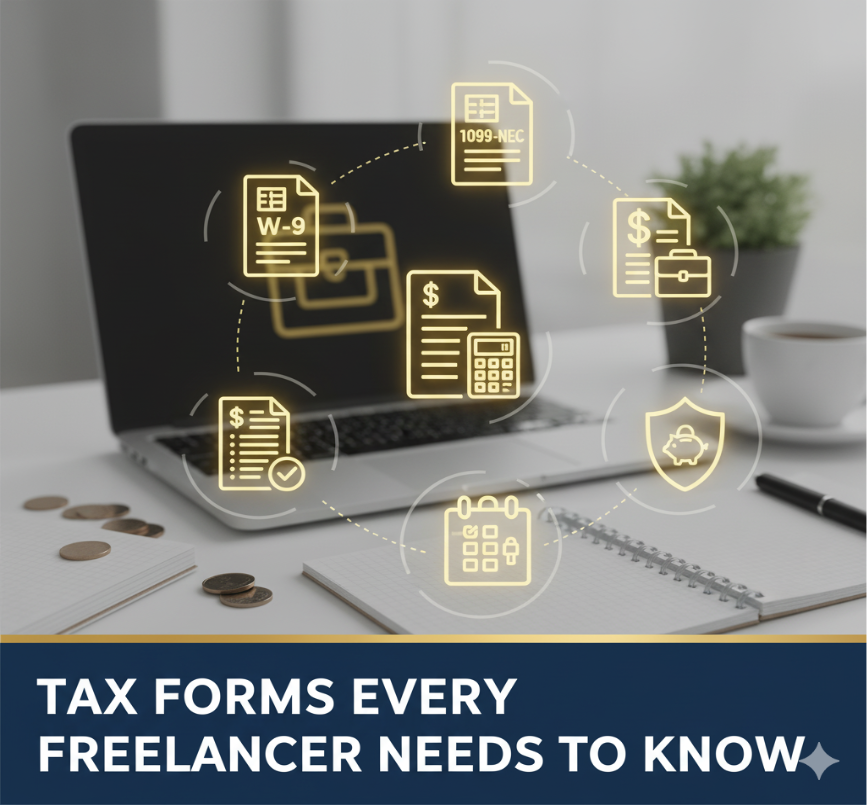
The following are the most essential tax forms a freelancer needs to be aware of, how they function, and why it is a good fiscal decision on the path to long-term success.
1. Form W-9 – The Beginning of Accurate Tax Reporting
Most clients will ask for a Form W-9 before payment to obtain your legal name, address, and taxpayer identification number.
This form will enable them to report correctly how much they’re paying you to the IRS. It’s especially useful to be aware of this form because it enables the establishment of professionalism and trust with clients.
Proper filing of tax forms also prevents delays or errors down the road when clients undertake end-of-year reporting.
Though the W-9 is not submitted to the IRS, it serves as the foundation for all subsequent reporting. Freelancers can make duplicates and keep their information up to date at all times.
By returning the W-9 promptly, you signal to clients that you are professional about your business and working above board.
2. Form 1099-NEC – Reporting Client Income
By the time the year comes to a close, any client who paid you a total of $600 or more will be required to send you Form 1099-NEC. This form will show precisely how much they paid you, and you’ll use it to report your freelance income.
However, even if you do not receive a 1099-NEC, you are still legally required to report all your earnings.
Being aware of this form enables you to track earnings from different clients and ensure your tax return accurately reflects them. Freelancers receive multiple 1099-NEC forms, and separating them helps avoid confusion and income loss.
This is a significant report because the duplicates are also sent to the IRS, and the disparities can lead to an audit.
By verifying each 1099-NEC and matching it against your existing records, you can report with certainty and precision.

3. Schedule C (Form 1040) – Reporting Profit and Deductible Expenses
The best advantage of freelancing is the ability to deduct legitimate business expenses. Schedule C is where you report your income and allowable deductions to determine your tax profit or loss.
It also lists categories that include equipment, travel, office supplies, software, professional fees, and more. Schedule C, if used effectively, can reduce the amount of taxes that you owe by decreasing your net income.
It also encourages you to keep your finances organized throughout the year. Freelancers who understand Schedule C can make more informed financial decisions, plan effectively, and project confidently, knowing that all eligible deductions are captured.
4. Schedule SE (Form 1040) – Computing Self-Employment Tax
Freelancers, in contrast to employees, pay both the employer and employee portions of Social Security and Medicare taxes.
Schedule SE will calculate this self-employment tax based on your Schedule C net earnings. While this additional tax has been a surprise for some first-time freelancers, knowing about it ahead of time means you can plan for it and won’t be caught off guard by a higher-than-expected bill.
The good news is that you can deduct the “employer portion” of the self-employment tax, which lowers your taxable income.
Being aware of Schedule SE helps you stay in compliance and avoid underpayment penalties. Planning for self-employment tax during the year keeps you solvent and gives your freelance business the respect it deserves.

5. Form 1040-ES – Quarterly Estimated Tax Payments
Freelancers are not able to pay taxes only at tax time. Form 1040-ES enables you to pay estimated tax every quarter and to figure it.
These quarterly payments consist of income tax and self-employment tax. Quarterly payment may be inconvenient, but it has several advantages: it avoids year-end large bills, does not incur penalty charges, and keeps finances in order.
Successful freelancers have a habit of setting aside some portion of the payment made to them and making accurate estimates by filing Form 1040-ES.
Managing quarterly taxes as a regular business practice ensures consistency and maintains financial order.
6. Form 8829 – Home Office Deduction
If you operate a business from your home and have one room that is used only for business, you can qualify for the home office deduction.
Form 8829 calculates the amount of mortgage, rent, utilities, and internet costs that are tax-deductible based on the space ratio used for business.
In addition, Form 8829 converts daily living expenses into legitimate business deductions, which reduce your taxable income and increase your savings. Accuracy is key—your work area must be used regularly and exclusively for business purposes.
Moreover, Form 8829 promotes better record-keeping and financial awareness. Completed properly, it allows freelancers to claim maximum deductions while avoiding infringement of IRS regulations.

Closing Remarks
These tax forms place the power of compliance, tax minimization, and operating with confidence firmly in the hands of freelancers.
Once you know what each form is used for and how to complete it, you make tax time more orderly than frenetic.
With the right information and preparation, freelancing isn’t only flexible and fulfilling, but also financially secure.